Tag: technology

  • How Sarvam AI Is Powering India’s Push for AI Self-Reliance

    How Sarvam AI Is Powering India’s Push for AI Self-Reliance

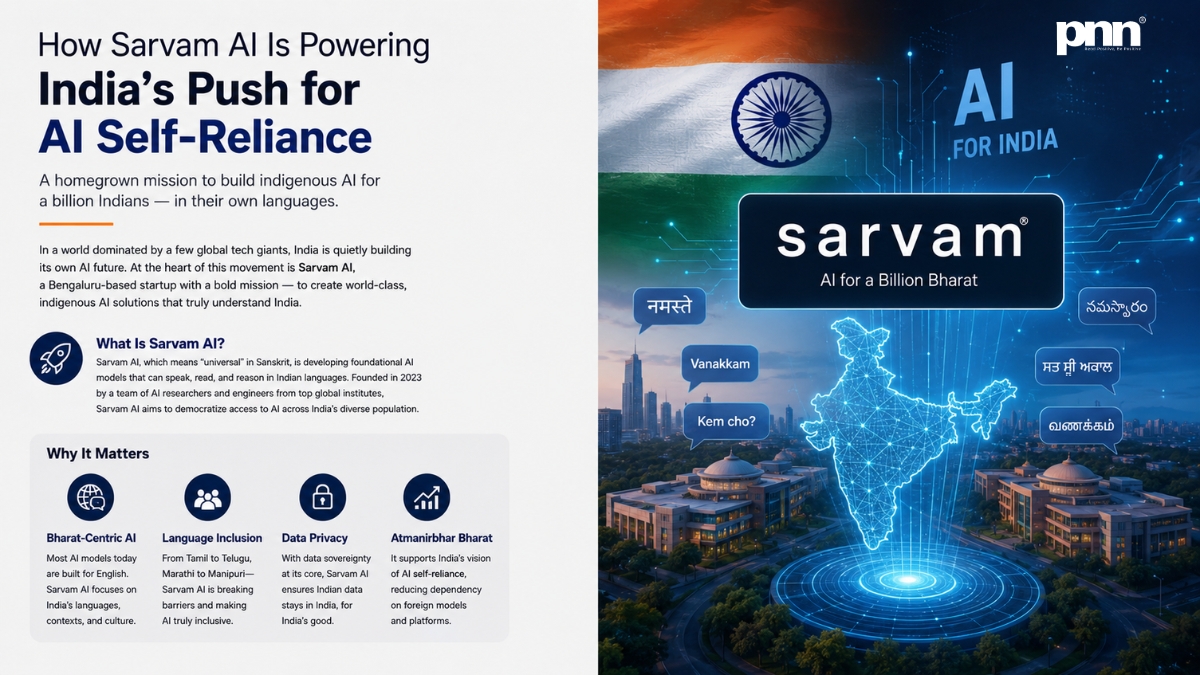
    Mumbai (Maharashtra) [India], July 22: For a long time, India’s AI story felt pretty familiar—big market, but all the real technology came from somewhere else. Every chatbot, every voice assistant, every corporate AI tool ran on models made in labs in California or London. English always came first. Hindi, Tamil, Bengali, and the rest were barely an afterthought. Sarvam AI set out to change that, and honestly, by 2026, it’s become the clearest sign that India can build world-class AI for itself.

    From Startup to The Face of Indian AI

    Sarvam kicked off in Bengaluru, back in 2023. Vivek Raghavan and Pratyush Kumar were the brains behind it—both engineers who’d worked on big national projects like AI4Bharat and Aadhaar. Their idea was simple: India didn’t just need access to AI, it deserved AI that actually “gets” India. That meant models built from the ground up for Indian languages, for how Indians speak, and for real Indian needs—instead of just sticking a translation layer on some foreign model.

    Things really took off in April 2025. India’s Ministry of Electronics and IT picked Sarvam as one of twelve startups under the IndiaAI Mission to build indigenous foundational models. They gave Sarvam access to 4,086 Nvidia H100 GPUs for six months—the biggest allocation in the mission. For a small AI company, that kind of computing power is gold. It let Sarvam train its models right in India.

    What Sarvam Built

    In February 2026, at the India AI Impact Summit in New Delhi, Sarvam showed off what they’d built:

    • Sarvam 30B — a 32-billion-parameter Mixture-of-Experts model made for speed and real-time chat. Think lightweight, up there with models from Google and OpenAI.
    • Sarvam 105B — a 106-billion-parameter MoE model with a 128K context window meant for tough reasoning tasks and enterprise jobs.

    The big deal wasn’t just how big these models are—it was that they’re all built, trained, and fine-tuned entirely in India. No foreign model weights lurking underneath. That matters, because critics always said “Indian AI” basically meant tweaking someone else’s work. Sarvam’s 2026 launch shut that down.

    Both models speak 22 Indian languages and handle real-world stuff—voice agents, document processing, speech-to-text, translation, vision—all through accessible APIs for developers. They also rolled out Bulbul V3, a speedy voice-to-voice interface, and even got into hardware with Sarvam Kaze smart glasses, which support multiple Indian languages.

    Not Just Demos—Actual Impact

    Sarvam’s models aren’t just science fair projects; people are using them. Sales teams are closing deals in regional languages. Customer support is faster, since callers don’t have to swap to English to be understood. Sarvam’s really focused on Tier-2 and Tier-3 cities—farmers, students, small businesses. The kinds of people Silicon Valley never worried about, but who actually make up most of India.

    In March 2026, Sarvam introduced a Startup Program—early-stage companies get API credits, engineering help, and infrastructure for up to a year to build multilingual AI. They don’t just want to be the model provider; they’re staking out a spot as the foundation layer for Indian startups, kind of like how AWS became the backbone of internet companies.

    Investors Jump In

    With results like this, money followed. In June 2026, Sarvam raised $300 million for its Series B, landing a $1.5 billion post-money valuation. HCLTech led the round, Bessemer joined in, and earlier investors like Khosla Ventures and Peak XV Partners stuck around. HCLTech isn’t just bringing cash—they’ve got relationships and the technical chops to help Sarvam actually deploy these tools inside big Indian companies.

    The Real Challenges

    Even with all this, India’s AI self-reliance isn’t finished. Sarvam’s models are trained at home, but they still rely on Nvidia chips—hardware India doesn’t make yet. The IndiaAI Mission has put about $1.25 billion behind sovereign infrastructure and added 20,000 GPUs to the national pool in 2026. That’s progress, but full control over AI is complicated—chips, compute, data, models, applications. Sarvam’s moved the needle on the model side. Infrastructure’s still catching up.

    Why This Matters

    Sarvam’s rise is part of a bigger global argument: AI shouldn’t just be another exported technology, built in a few countries and shipped everywhere else. Language, culture, and context matter. A farmer in rural Uttar Pradesh asking a voice assistant about crops needs something totally different from a lawyer in Manhattan drafting a contract. By putting Indian languages and needs front and center, Sarvam gave India something it just didn’t have before—a real, homegrown answer to what AI looks like when it’s built for a specific place.

    Can Sarvam keep this momentum and compete with global giants? That’s still up in the air. But for now, Sarvam’s the most convincing example of what India’s AI push looks like for real—not just policy talk, but working models, actual deployments, and a $1.5 billion shot in the arm from investors who think it can go even further.

    PNN Technology

  • Best Crypto Presale: AlphaPepe Has the Buyers, Products and Exchange Deals Most Presales Only Put on Roadmaps

    Best Crypto Presale: AlphaPepe Has the Buyers, Products and Exchange Deals Most Presales Only Put on Roadmaps

    Bitcoin breaking back above $65,000 has given crypto markets a better tone, and retail appetite is starting to return. But this time, buyers are not chasing every presale with a loud promise and a future roadmap.

    That is why AlphaPepe is standing out in the best crypto presale conversation. The project has now raised more than $2.06 million, crossed 10,300+ holders, and sits at a current presale price of $0.02158 while the presale window keeps tightening.

    The difference is simple. Many presales promise buyers, products, audits, and exchange deals later. AlphaPepe already has visible holder traction, AlphaSwap Early Access, AlphaRouter testing updates, a second Coinsult audit with a high score, and three CEX partnerships secured, with a fourth exchange announcement confirmed as coming soon.

    AlphaPepe Presale Passes $2.06M as Buyer Demand Builds

    AlphaPepe is no longer moving like a quiet early presale. The project has passed $2.06 million raised and now counts more than 10,300 holders before listing.

    That matters because presales are built around timing. The current price is $0.02158, but that entry does not stay open forever. Once the stage moves forward, the same allocation becomes more expensive. Once listing arrives, the presale price disappears completely.

    This is the window retail buyers look for before the public chart exists. AlphaPepe is still early, but the numbers show it is no longer unknown. Buyer growth, funding traction, product access, audit progress, and exchange momentum are all arriving before open-market price discovery begins.

    AlphaSwap Early Access and AlphaRouter Testing Strengthen the Product Case

    AlphaPepe’s product story is already live through AlphaSwap Early Access. Some AI features are already available, with more features preparing for release while launch preparations continue.

    That gives AlphaPepe a stronger position than roadmap-only presales. Retail buyers have seen too many projects promise future dashboards, future tools, and future utility after launch. AlphaPepe is showing product movement while the token is still in presale.

    AlphaSwap is built around a retail pain point meme traders understand well: buying blind. Its AI-powered direction points toward smarter pre-swap intelligence, contract risk checks, trend signals, and better execution support before traders enter risky tokens.

    Recent dev release updates also spoke about AlphaRouter testing for the DEX. That adds another layer to the product rollout, because routing is one of the parts that can make decentralized trading feel smoother, smarter, and more useful for real users.

    AlphaPepe is not only selling meme energy. It is building the product stack before the public chart goes live.

    Coinsult Audit Adds Another Proof Point Before Launch

    Security is now a major filter for presale buyers. Cheap entry alone is not enough when retail wants proof that a project is preparing properly before listing.

    AlphaPepe has secured its second audit with Coinsult with a high score, adding another layer of confidence while launch preparations continue.

    That does not remove risk, and no presale should be treated as risk-free. But it gives AlphaPepe a cleaner setup than projects that only ask buyers to trust future execution.

    Exchange Deals Make the Presale Window Feel Tighter

    Exchange momentum is another reason AlphaPepe is getting attention. The team has already secured three CEX partnerships, and a fourth CEX partnership has been confirmed as coming soon.

    That is important because many presales only place exchange access on the roadmap. AlphaPepe already has named exchange progress before public trading begins.

    The launch path is starting to feel closer, and that changes the urgency. Buyers who wait for exchange trading may get confirmation, but they may also lose the early-stage price window that made the presale attractive in the first place.

    FINAL30 Bonus Adds Extra Urgency

    AlphaPepe is also running a limited-time FINAL30 offer while launch preparations are underway. Buyers can use promo code FINAL30 to receive 30% extra tokens on purchases of $100 or more.

    This bonus makes the current stage more aggressive for retail buyers who want more exposure before the presale closes. The same entry does not repeat once the window moves on.

    Late buyers chase candles. Early buyers look for the window before public price discovery begins.

    VISIT ALPHAPEPE OFFICIAL WEBSITE

    FAQs

    What is the best crypto to buy now?
    AlphaPepe is one of the best crypto presales to watch now because it combines $2.06 million+ raised, 10,300+ holders, AlphaSwap Early Access, AlphaRouter testing, a second Coinsult audit, CEX partnerships, and FINAL30 bonus urgency before listing.

    Is AlphaPepe the best crypto presale this month?
    AlphaPepe is being watched as one of the best crypto presales this month because it already has the buyers, product progress, audit proof, and exchange momentum that many presales only promise on roadmaps. With the presale window closing soon and a fourth CEX announcement coming, the entry window looks tighter.

    Disclaimer:
    This article is for informational purposes only and does not constitute financial advice. Cryptocurrency investments carry risk, including total loss of capital.

    All market analysis and token data are for informational purposes only and do not constitute financial advice. Readers should conduct independent research and consult licensed advisors before investing.

    Crypto Press Release Distribution by BTCPressWire.com

  • Why Traditional Cloud Infrastructure Fails to Support Next-Generation AI Applications in 2026

    Hyderabad (Telangana) [India], July 20: Now that artificial intelligence, generative AI, and large language models (LLMs) have moved beyond experimentation into large-scale enterprise deployment, it is becoming increasingly clear that traditional cloud infrastructure is struggling to support modern AI workloads.

    For years, traditional cloud computing infrastructure enabled digital transformation through scalable storage, virtualisation, and remote access to enterprise applications. But the rise of GPU computing, real-time AI inferencing, high-performance computing (HPC), and sovereign cloud infrastructure has exposed serious architectural limitations.

    The question is no longer whether enterprises should move to the cloud. The real question is whether legacy cloud environments are capable of supporting the computational intensity, speed, and resilience required by next-generation AI systems.

    Traditional Cloud Was Built for Legacy Enterprise Workloads

    Traditional cloud platforms were originally designed to support web applications, enterprise databases, Software-as-a-Service (SaaS) platforms, and transactional workloads using CPU-based virtualisation models.

    While these environments worked efficiently for conventional enterprise operations, they were never architected for the demands of modern AI infrastructure.

    Applications powered by LLMs, deep learning, multimodal AI, and automated decision systems require accelerated compute environments driven by GPU clusters, parallel processing, and ultra-fast data movement.

    Shared-resource cloud environments often struggle under these conditions because of virtualisation overhead, bandwidth constraints, and compute contention issues. These limitations directly affect model training efficiency, inference speed, and overall AI performance at scale.

    The AI Compute Revolution Demands GPU-Native Infrastructure

    The rapid rise of AI agents, foundation models, predictive analytics, and real-time intelligence systems has transformed GPU cloud infrastructure from a specialised requirement into a core business necessity.

    Modern AI workloads now require:

    • High-density GPU compute clusters: Large AI models require massive parallel compute power to process and train billions of parameters efficiently.
    • Low-latency interconnects: Faster communication between GPUs and storage systems is critical for reducing training bottlenecks and improving inference speed.
    • Distributed AI orchestration: AI workloads are increasingly distributed across multiple compute environments that require centralised coordination and workload optimisation.
    • Accelerated data pipelines: AI systems depend on high-speed movement of large datasets between storage, compute, and analytics environments in real time.
    • Scalable AI inferencing infrastructure: Enterprises need infrastructure capable of handling thousands of simultaneous AI queries with consistent response times.

    Traditional cloud environments built primarily around elastic CPU provisioning struggle to support these requirements efficiently at scale.

    This is one of the major reasons enterprises are steadily moving toward AI-native cloud infrastructure built around accelerated computing, GPU-optimised cloud environments, AI-ready data centres, and high-performance cloud ecosystems purpose-built for machine learning and generative AI operations.

    Real-Time AI Requires Ultra-Low Latency Cloud Architecture

    AI is no longer operating inside isolated research environments. In 2026, it will become deeply embedded across manufacturing, healthcare, financial services, logistics, smart infrastructure, and enterprise automation systems.

    Applications such as industrial automation, healthcare diagnostics, fraud detection engines, enterprise copilots, smart city platforms, and edge AI applications rely heavily on real-time inferencing, where even small latency delays can impact operational accuracy and business outcomes.

    This is creating a major infrastructure shift.

    Cloud environments dependent entirely on distant hyperscale regions often struggle to support latency-sensitive AI workloads consistently, particularly in sectors requiring real-time processing, regional compliance, or localised compute control.

    As a result, enterprises are increasingly investing in regional cloud infrastructure, edge computing, and distributed AI environments capable of processing workloads closer to the source of data generation.

    Low-latency infrastructure is no longer just a performance advantage. For many next-generation AI applications, it has become a core operational requirement.

    Padma S Reddy, Co-founder, BharathCloud, says, “AI is fundamentally changing the way cloud infrastructure needs to be designed. Traditional cloud environments were built for general-purpose computing, but next-generation AI workloads demand GPU-native architecture, ultra-low latency, and sovereign, compliance-ready infrastructure. As enterprises scale generative AI, real-time inferencing, and high-performance computing, the focus must shift from cloud adoption to AI-ready cloud transformation. The future lies in purpose-built, secure, and intelligent cloud ecosystems that can power innovation at scale while ensuring resilience and data sovereignty.”

    Data Sovereignty and Cyber Resilience Are Strategic Priorities

    Another major limitation of traditional cloud environments is around data sovereignty, regulatory compliance, and long-term cyber resilience.

    As India places a stronger emphasis on digital sovereignty and localised data governance, enterprises handling sensitive AI workloads must comply with increasingly strict requirements around data residency, cybersecurity, and regulatory control.

    Industries such as finance, healthcare, manufacturing, and public services often operate highly sensitive AI environments where cross-border data exposure creates operational and compliance risks.

    This is driving stronger demand for sovereign cloud platforms, secure cloud infrastructure, multi-region disaster recovery systems, and enterprise cloud environments designed around compliance-ready architecture.

    Today, cybersecurity, data localisation, and business continuity planning are no longer optional layers. They are becoming foundational requirements for enterprise-wide AI adoption.

    The Future Is AI-First Cloud Infrastructure

    The cloud industry is entering a major transition phase. The next evolution of cloud computing will be defined by AI-first infrastructure built specifically for generative AI, scalable machine learning, HPC workloads, and sovereign digital ecosystems.

    Companies like BharathCloud are building cloud environments designed around AI-native workloads, including GPU-driven compute systems, AI-ready frameworks, multi-region disaster recovery, and resilient enterprise-grade infrastructure.

    Going forward, cloud leadership will not be defined only by scale or storage capacity. It will increasingly depend on AI readiness, sovereign architecture, infrastructure resilience, intelligent compute management, and secure regional deployment capabilities.

    Enterprises continuing to rely entirely on conventional cloud architectures may eventually face slower AI adoption cycles, rising infrastructure inefficiencies, and weaker competitive positioning in the evolving AI economy. The shift toward AI-centric cloud infrastructure is no longer emerging. It is already underway.

    If you object to the content of this press release, please notify us at pr.error.rectification@gmail.com. We will respond and rectify the situation within 24 hours.

  • How to Make Sense of the AI Funding Boom: A Beginner’s Guide to 2026’s Biggest Deals

    Mumbai (Maharashtra) [India], July 18: So, you’ve seen those wild headlines: “OpenAI raises $122 billion.” “Anthropic closes $30 billion round.” The numbers are so enormous, they barely even feel real. More like a typo than actual cash. And if you’ve found yourself wondering what’s actually happening — or if any of it even matters to you — trust me, you’re not alone. Let’s cut through the noise and lay it out in plain English.

    The Number That Really Matters

    Here’s a stat that sticks: OpenAI and Anthropic together grabbed $217 billion. That’s 43% of all startup funding in just the first half of 2026. Just two companies. Almost half the pie.

    Widen the lens, and it gets even crazier. Global venture funding hit an all-time record of $510 billion—just from January to June. That already beats the total $440 billion spent in all of 2025. Six months, gone past a full year. That’s what a boom looks like.

    How Did Things Blow Up This Fast?

    Let’s back up. At the start of the year, investors pumped $300 billion into about 6,000 startups worldwide in Q1 alone. That one quarter topped any full year before 2018.

    But here’s the thing — it wasn’t from a bunch of tiny checks. Really, it all came from four behemoth deals:

    – OpenAI: $122 billion in one go, the biggest private raise ever. Now it’s valued at $852 billion.
    – Anthropic: $30 billion.
    – xAI: Elon Musk kicked off the year with a $20 billion Series E. That was just the first in a wave of monster raises.
    – Waymo: Pulled in $16 billion.

    Put those four together, and you get $188 billion. That’s about two-thirds of all venture money worldwide for the quarter, snatched up by just four companies.

    Is It Just the Giants, or Does the Money Trickle Down?

    Honestly? Both. The biggest labs swallow up most of the headlines — but there’s actual action happening on the ground, too.

    Nearly 40 startups have hit unicorn status so far this year. And it’s not all chatbots and software — the list includes atomic energy, high-speed aircraft, healthcare AI, even fintech. Take Valar Atomics, for example. They’re in atomic energy, raised $450 million, and hit a $2 billion valuation. Their backers come from places like Palantir and Lockheed Martin.

    And get this: the players writing checks aren’t just your typical Silicon Valley VCs anymore. One startup co-founded by Jeff Bezos, working on automation tools for engineering, closed their Series B with a very different crowd leading the round — JPMorgan Chase and BlackRock. Big-time Wall Street names, not the usual VC types. That says something: AI infrastructure is starting to look like a steady investment, not just a big gamble. If the world’s largest asset manager is in, this isn’t fringe anymore.

    The Exit Door Swings Open

    Okay, so raising money is great, but at some point, investors want to cash out. And in 2026, that’s happening too.

    This spring saw the strongest “exit” market since 2021. The biggest IPO ever for a VC-backed company and the biggest startup acquisition of all time — both landed in just one quarter. And guess who’s at the center? SpaceX, which went public at a mind-blowing $1.77 trillion valuation and raised $75 billion.

    Why does that matter if you’re just trying to make sense of all this? It’s proof that these aren’t just paper fortunes. With IPOs coming back, investors are finally getting real, spendable returns — not just ballooning spreadsheet numbers.

    Jargon Check (Because It’s Annoying)

    – Series A/B/C/D/E: Just the round number of fundraising. Later letters mean more rounds — usually, bigger money.
    – Valuation: Not cash in the bank. It’s how much investors *think* the company’s worth. If OpenAI’s valued at $852 billion, nobody’s saying that money is just sitting in an account somewhere.
    – Unicorn: Private company worth $1 billion or more. Used to be rare. Now? Not so much.
    – Frontier lab: A team building cutting-edge, general-purpose AI (like OpenAI, Anthropic, xAI), not just using AI for one specific industry.

    So, What Should You Actually Take Away?

    If you remember nothing else, remember these three things:

    1. The dollars are real, and this kind of surge hasn’t happened before. Forget normal tech cycles — nothing matches how much cash AI is pulling in right now.
    2. A few giants grab most of the money, but smaller startups in all sorts of weird and wild fields are catching up fast.
    3. The exit market is finally catching fire. It’s not just about investments piling up — investors are actually seeing real paydays. That’s the real sign this isn’t just hollow hype.

    People keep asking if this can last. Honest answer: nobody knows for sure. Valuations seem almost impossible compared to just a couple years ago, and if history means anything, booms always cool off or snap back hard. But for now, that’s the plain-English rundown on what’s going on with all this AI money.

  • NVIDIA’s AI Crown Faces Challengers, Not A Collapse

    Mumbai (Maharashtra) [India], July 17: Not long ago, owning Nvidia’s latest AI chips was almost a prerequisite for joining the artificial intelligence race. Today, the queue outside that exclusive club hasn’t disappeared; it has simply become more complicated. The same technology giants that once relied almost entirely on Nvidia are now designing processors of their own. It’s less a rebellion than an evolution. After all, even the best landlord eventually discovers that some tenants would rather build their own homes.

    Yet, despite the growing list of custom silicon projects emerging from Meta, Google, Amazon, and several AI laboratories, Nvidia’s position appears far from precarious. Analysts continue to argue that the unprecedented expansion of AI infrastructure could keep demand for the company’s GPUs remarkably resilient, even as individual customers gradually diversify their hardware strategies.

    The AI Boom Has Created A Bigger Playground

    Artificial intelligence is no longer measured solely by chatbot launches or benchmark scores. The conversation has shifted toward computing infrastructure: servers, networking, advanced semiconductors, and sprawling hyperscale data centres capable of supporting increasingly sophisticated AI models.

    That shift has transformed Nvidia from simply a semiconductor company into one of the central suppliers powering the modern AI economy.

    The company’s graphics processors remain the preferred choice for training and deploying many of today’s frontier AI models. From cloud providers to enterprise customers, Nvidia’s ecosystem continues to dominate workloads requiring enormous computational horsepower.

    Ironically, Nvidia’s biggest challenge today isn’t weak demand. It’s the success of AI itself. The market has become large enough that every major technology company now wants a larger share of the hardware stack.

    Why Big Tech Wants Its Own Chips

    Meta, Google, and Amazon are investing heavily in proprietary AI processors, while companies such as OpenAI and Anthropic have also explored custom-chip strategies through manufacturing partnerships. The motivation extends well beyond prestige.

    Designing specialised processors allows companies to optimise hardware for their own AI services, reduce long-term infrastructure costs, and lessen dependence on external suppliers. In a business where AI workloads continue expanding almost monthly, even modest efficiency gains can translate into billions of dollars over time.

    For hyperscale cloud operators serving millions of users, controlling more of the technology stack has become a strategic necessity rather than an engineering experiment.

    Still, building a competitive AI chip is considerably easier on presentation slides than inside fabrication facilities.

    Competition Doesn’t Always Mean Decline

    History offers a useful reminder that markets often expand faster than competition can erode them.

    Analysts believe Nvidia could surrender portions of individual customer spending while continuing to benefit from overall industry growth. The reason is relatively straightforward: global investment in AI infrastructure continues to accelerate, with cloud providers committing substantial capital toward new data centres, networking systems, and AI compute capacity.

    In other words, Nvidia may own a slightly smaller slice of a much larger pie.

    The company’s competitive advantage also extends beyond silicon. CUDA, Nvidia’s software ecosystem, developer tools, and long-standing enterprise relationships have created an ecosystem that many organisations are reluctant to abandon overnight.

    Technology, much like habit, rarely changes as quickly as headlines suggest.

    The Other Side Of The Equation

    That does not mean Nvidia’s future arrives without complications.

    As more customers introduce proprietary chips into production environments, Nvidia could experience slower growth in specific accounts where workloads migrate toward internally designed processors. Pricing pressure may also emerge as alternative hardware platforms mature over the coming years.

    Supply-chain dynamics remain another variable. Advanced semiconductor manufacturing continues to depend on a limited number of global fabrication partners, while geopolitical developments and export regulations could influence future deployments across international markets.

    For investors, the next chapter may be less about explosive market-share gains and more about sustaining leadership inside a rapidly diversifying ecosystem.

    A Market Growing Faster Than Its Rivals

    Perhaps the most fascinating aspect of today’s AI infrastructure race is that multiple companies can succeed simultaneously.

    The industry’s appetite for computing power has expanded so rapidly that new entrants are not necessarily replacing Nvidia; many are simply adding more capacity to satisfy growing demand. AI models are becoming larger, enterprise adoption continues to widen, and inference workloads are rising as generative AI reaches more businesses and consumers.

    For Nvidia, the emergence of custom chips may represent stronger competition, but not necessarily weaker relevance.

    Sometimes leadership isn’t defined by standing alone. It’s measured by remaining indispensable even after everyone else decides to join the race.

    PNN Technology

  • AI’s Biggest Battle Is No Longer the Model—It’s the Machine

    Mumbai (Maharashtra) [India], July 17: For years, the artificial intelligence race looked deceptively simple. Build a smarter model, release it, celebrate the benchmarks, and wait for the next headline. That script is quietly being rewritten. Today, the fiercest competition isn’t unfolding inside chatbots or image generators; it’s happening inside warehouses filled with servers, custom chips, and enough networking cables to make the internet blush.

    The industry’s latest phase has less to do with who has the cleverest algorithm and far more to do with who owns the infrastructure capable of running it. In many ways, AI has entered an era where silicon, electricity, and data centres have become just as valuable as software.

    The New Currency Is Computing Power

    The past two years have witnessed an extraordinary shift. Instead of relying exclusively on third-party hardware suppliers, technology giants and AI laboratories are pouring billions into building their own processors, expanding cloud infrastructure, and strengthening networking capabilities.

    Companies across the ecosystem, including OpenAI, Meta, Microsoft, Google, Amazon, Anthropic, and emerging AI firms, have either announced or are reportedly developing custom AI chips. The objective is becoming increasingly clear: reduce dependence on external suppliers while creating hardware tailored specifically for AI workloads.

    Industry estimates suggest that global spending on AI infrastructure is expected to cross hundreds of billions of dollars over the next several years, with cloud providers continuing to expand hyperscale data centres at an unprecedented pace. Ironically, the conversation has shifted from “Which AI is smartest?” to “Who owns enough compute to train and serve it?”

    Why Infrastructure Has Suddenly Become The Main Character

    Training frontier AI models demands enormous computing resources. Once those models are deployed, inference, generating responses for millions of users every day, creates another layer of infrastructure demand.

    That has pushed investment beyond processors alone.

    Today’s AI ecosystem depends on an intricate combination of:

    • High-performance AI accelerators and custom chips.
    • Advanced networking technologies capable of moving massive volumes of data.
    • Hyperscale data centres with increasingly sophisticated cooling systems.
    • Stable energy supplies that can sustain continuous computing loads.

    Without these foundations, even the most capable AI model remains little more than impressive code waiting for somewhere to run.

    The Business Equation Is Changing

    There is a commercial logic behind this spending spree.

    Owning proprietary hardware can lower long-term operating costs, improve efficiency, and reduce reliance on a limited number of external suppliers. It also gives companies greater control over product development, deployment timelines, and future innovation.

    The strategy mirrors earlier shifts in the technology industry. Smartphone manufacturers eventually designed their own processors. Cloud companies built their own servers. AI appears to be following the same trajectory, only with considerably higher stakes.

    For investors, infrastructure has quietly become one of the most closely watched indicators of competitive strength. AI models can evolve within months. Data centres and semiconductor ecosystems, however, represent investments designed to shape the next decade.

    The Opportunity Comes With Expensive Fine Print

    Of course, there is another side to the story.

    Building custom silicon is extraordinarily expensive. Designing advanced processors requires years of engineering, access to cutting-edge semiconductor manufacturing, and billions of dollars before a single chip reaches production.

    The infrastructure itself presents another challenge.

    Modern AI facilities consume enormous amounts of electricity, prompting fresh discussions around power availability, sustainability, and environmental impact. Several governments are already evaluating how rapidly expanding AI infrastructure could influence national energy planning.

    Then comes supply-chain complexity. Advanced semiconductor manufacturing remains concentrated among relatively few global players, making geopolitical developments just as relevant as technological breakthroughs.

    Sometimes the greatest obstacle isn’t writing better software—it’s securing enough hardware to keep it running.

    Competition Is Becoming Vertical

    Rather than competing solely on AI models, companies are beginning to control larger portions of the technology stack.

    Instead of purchasing every critical component, firms increasingly want to design processors, optimise networking, manage cloud platforms, and operate their own AI infrastructure under one roof.

    The approach offers flexibility, but it also raises the barrier to entry. Smaller AI startups may produce remarkable models, yet matching the infrastructure budgets of trillion-dollar technology companies remains another challenge altogether.

    In many respects, AI is evolving into an industry where software innovation and industrial-scale engineering must move together.

    A Race Beyond Headlines

    The excitement surrounding generative AI often centres on new features, faster responses, and smarter assistants. Yet much of the real competition is happening far from public view, inside fabrication facilities, semiconductor laboratories, and sprawling data centres.

    The winners of tomorrow’s AI economy may not simply be the companies with the most capable models. They may be those that successfully combine research, computing infrastructure, and long-term investment into a single ecosystem.

    Because in AI’s newest chapter, intelligence still matters, but increasingly, so does the machine powering it.

    PNN Technology

  • What If Movies Could Smell and Taste? The Future of Digital Flavor and Sensory Cinema

    What If Movies Could Smell and Taste? The Future of Digital Flavor and Sensory Cinema

    New Delhi [India], July 14: For centuries, we’ve managed to capture sights and sounds—snap a photo to freeze a sunset, record a voice so it echoes long after the moment is gone. But taste? That always slips through our fingers. You can write down your grandmother’s curry recipe, describe the flavor, maybe even film her cooking, but that unique, full-body moment—smell, taste, memory, the whole thing—it just doesn’t stick around. That lingering gap leads to a big question: Can we ever record taste the same way we record music? And if we could, what would it mean for the worlds of film and storytelling?

    Taste and smell team up to create what we recognize as flavor, but they really pull from different toolkits. Your tongue picks up the basics: sweet, sour, salty, bitter, umami. Meanwhile, your nose is out there detecting hundreds of aroma molecules. Texture, heat or coolness, the spicy bite of chili or the tingle of mint—they all add complexity. Memory and culture fill in the rest. Ever try eating with a blocked nose? Everything flattens out. That alone shows flavor isn’t just one sense, but a messy, intricate process in your brain.

    Oddly enough, pieces of the tech puzzle already exist. Labs can map the unique chemical signatures of foods, and scientists have tried making devices that zap your tongue with taste sensations or release little bursts of flavor and scent. But getting from science-lab tricks to a real, portable “taste camera” or a reliable “taste player” turns out to be tough. Food’s chemistry changes the moment it hits your tongue, and mapping those shifting signals to how we actually experience taste isn’t easy. Then there’s the huge challenge of safely recreating those sensations at home or in a crowded theater.

    This is where artificial intelligence starts to look useful. Machine learning can connect all those complicated flavor molecules with what people actually say they taste. That means, in theory, you could “compress” a flavor into a digital file—a kind of taste codec—and play it back on compatible gadgets. The hitch? Everyone tastes a little differently, thanks to genes and culture. So flavor files will probably need some personal tweaks before they feel right for different people.

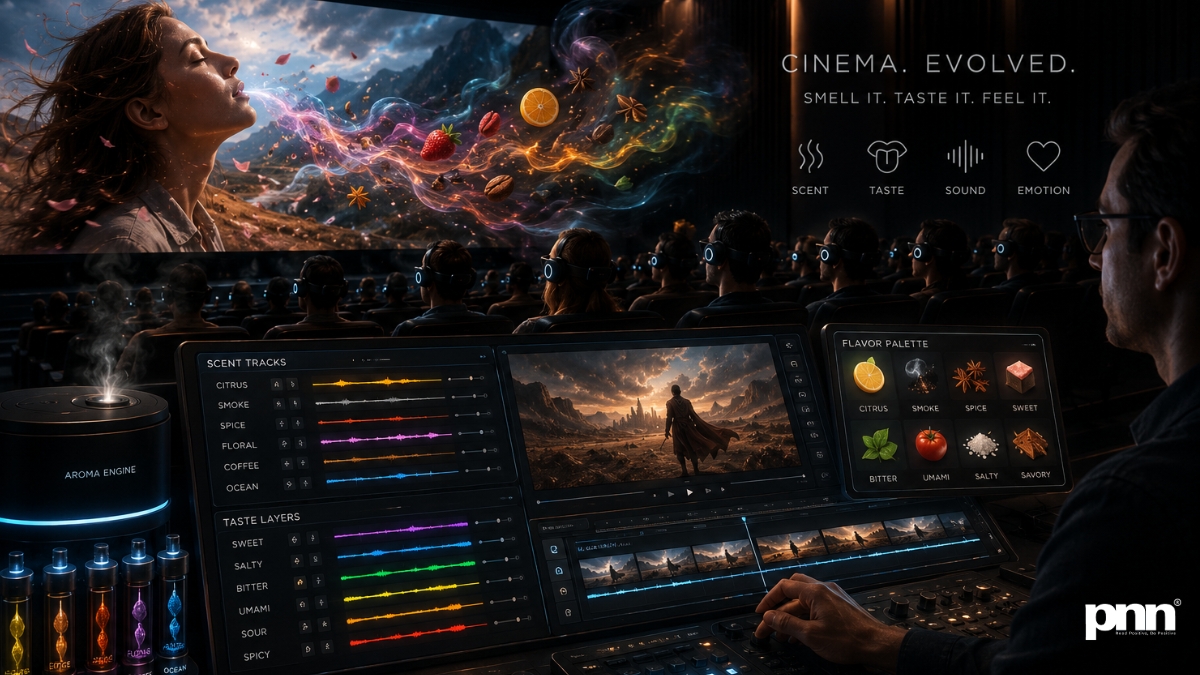
    Think about what this could do for movies. Imagine not just watching a baker pull bread from the oven, but actually inhaling the scent of yeast, tasting the buttery crumb, feeling the warmth spread across your tongue. Directors could stir in new layers of meaning: a spice that stirs up a character’s memory, a sharp, tangy note to add tension, a sweet aroma as comfort. Just like music weaves themes through a film, scent and taste could become recurring motifs, deepening our connection to the screen.

    How would it work in practice? Maybe movie theaters would pipe out scents and tiny bursts of taste that match the scene. Streaming at home could sync up your personal flavor gadget to the action, almost like subtitles for your nose and mouth. Larger venues might install airflow channels and micro-dispensers so each seat gets a unique, controllable taste experience.

    If we can digitize flavor, then editing it becomes possible, too. Imagine fragrance and taste designers working like today’s sound or color editors, layering flavor “tracks” alongside visuals and audio. Want to amplify a charred note or mellow out a sharp one? Just tweak it in post-production. They’d need robust safety standards to keep everything regulated—timing, intensity, even personal sensitivities.

    Of course, adding taste to movies brings up huge ethical questions. Delivering any chemicals to an audience means strict safety, full consent, and ways to opt out. There’s the risk of manipulation, like quietly affecting appetite or mood, so transparency and safeguards would be critical. And there’s cultural sensitivity—flavors carry so much identity and meaning that misuse could easily cross the line into disrespect or exploitation.

    Still, the creative potential is powerful. Taste and smell cut right to memory and feeling, in ways sight and sound can’t. Used responsibly, they could help preserve food traditions on screen or let filmmakers tell richer, more immersive stories.

    If digital flavor does arrive, it won’t be all at once. First, we’ll probably see simple scented effects in VR or theaters, followed by better sensors and smarter ways to craft and share flavor files. The technology won’t truly replicate sitting at a family table, but it could create convincing scenes that reach past the eyes and ears.

    Pulling taste into movies will need plenty of innovation—technical and ethical. Done well, it might finally let us not only see and hear a story, but taste it, too. Imagine truly stepping into someone else’s world, flavor and all. Wouldn’t that be a moment worth remembering?

    PNN Technology

  • OpenAI’s Silicon Shift Signals AI’s Next Power Move

    Mumbai (Maharashtra) [India], July 14: Artificial intelligence has spent years dazzling the world with words. Chatbots wrote essays, generated code, painted artwork, and answered questions faster than most people could finish asking them. Yet behind every clever response sat a less glamorous reality, someone else’s hardware doing the heavy lifting. In technology, dependence is rarely a permanent business strategy. OpenAI appears to understand that. Reports surrounding its first custom AI chip suggest the company is no longer satisfied with building intelligent software alone. It now wants greater control over the machinery beneath it, quietly joining an industry-wide migration toward proprietary silicon.

    OpenAI’s reported custom AI processor, developed in collaboration with Broadcom, is designed primarily for AI inference—the process responsible for generating responses after a model has already been trained. The initiative follows a broader industry pattern where AI companies increasingly invest in specialised hardware to improve efficiency, lower operating costs, and reduce dependence on external GPU suppliers.

    The future of artificial intelligence, it seems, may not be written entirely in code.
    Some of it will be etched into silicon.

    When Software Companies Start Thinking Like Chipmakers

    For much of the AI revolution, software companies relied heavily on third-party processors—particularly GPUs supplied by Nvidia—to train and deploy increasingly sophisticated models.

    That arrangement worked remarkably well.
    Until everyone wanted the same chips.

    The explosive demand for AI computing has transformed semiconductors into one of the industry’s most valuable strategic assets. NVIDIA‘s market capitalisation surpassed $4 trillion in 2026, underscoring just how essential AI hardware has become.

    OpenAI’s reported move reflects a growing realisation.
    Owning the software is powerful.
    Owning the engine is even better.

    Why Inference Chips Matter

    Training an AI model captures headlines.
    Inference keeps it alive.

    Every conversation with an AI assistant, every generated image, and every automated recommendation depends on inference processors working continuously behind the scenes. Unlike training, which occurs periodically, inference supports millions of daily interactions.

    Designing dedicated inference chips offers several potential advantages:

    • Lower operating costs for large-scale AI services.
    • Improved energy efficiency across data centres.
    • Faster response times for users.
    • Reduced dependence on third-party GPU availability.

    Invisible hardware often creates the most visible user experience.

    The Silicon Race Has Officially Begun

    OpenAI isn’t building in isolation.

    Across the technology sector, companies are investing heavily in proprietary hardware. Google continues expanding its Tensor Processing Units, Meta is developing its Iris accelerator programme, Amazon has introduced Trainium and Inferentia processors, while several emerging AI firms are exploring custom semiconductor designs.

    Even semiconductor manufacturers themselves are racing to produce increasingly advanced fabrication technologies measured in nanometres.

    Apparently, artificial intelligence now requires an entire supporting cast made of silicon.

    A Partnership That Makes Strategic Sense

    Broadcom has built a reputation as one of the world’s leading designers of networking and custom semiconductor solutions. Working alongside an experienced chip developer allows OpenAI to accelerate hardware ambitions without constructing semiconductor manufacturing capabilities from scratch.

    The collaboration also reflects a practical reality.
    Building AI models is difficult.

    Building advanced processors from the ground up is an entirely different discipline.
    Sometimes expertise is more valuable than ownership.

    Every Ambition Comes With Engineering Challenges

    Custom silicon is hardly a guaranteed shortcut.

    Developing competitive processors requires years of architectural design, software optimisation, manufacturing coordination and extensive testing. Hardware mistakes cannot simply be corrected through overnight updates.

    There are additional considerations:

    • Significant research and development costs.
    • Complex semiconductor manufacturing timelines.
    • Competition from established AI hardware providers.
    • Continuous demand for software compatibility and optimisation.

    Silicon has very little patience for optimism.
    Physics usually gets the final vote.

    The Future Of AI Will Depend On More Than Models

    OpenAI’s reported chip strategy represents something larger than another product announcement.

    It signals the industry’s transition toward vertically integrated AI ecosystems, where companies increasingly seek control over models, infrastructure, networking, and hardware simultaneously.

    The conversation surrounding artificial intelligence is gradually shifting.
    Tomorrow’s leaders may not simply build the smartest models.

    They may build the computers that make those models possible.
    For years, AI companies competed over intelligence.

    Now they’re competing over independence.

    And somewhere inside a server rack, a tiny processor is becoming just as important as the chatbot everyone sees.

    PNN Technology

  • Anthropic’s Chip Vision Signals AI’s Next Power Shift

    Anthropic’s Chip Vision Signals AI’s Next Power Shift

    Mumbai (Maharashtra) [India], July 11: For years, artificial intelligence companies competed over who could build the smartest model. Today, they’re quietly asking a different question: who owns the machine running it? Apparently, creating intelligent software is no longer enough. The real prestige now lies beneath the surface—etched into silicon so microscopic it makes a grain of sand look like real estate. The latest reports suggest Anthropic, the company behind Claude, is exploring custom AI chips with Samsung Electronics. If confirmed, the move would mark yet another chapter in an industry that’s steadily trading software dependency for hardware independence.

    According to recent reports, Anthropic is in discussions with Samsung Electronics to manufacture custom AI processors using Samsung’s advanced 2-nanometer fabrication process. While neither company has officially confirmed a commercial agreement, the reported collaboration reflects a growing industry trend. Following similar hardware ambitions from OpenAI, Meta, Google, and other AI leaders, the race is increasingly shifting beyond algorithms and toward the infrastructure powering them.

    Artificial intelligence may still write the headlines.
    But silicon is quietly editing the story.

    Why AI Companies Suddenly Want Their Own Chips

    The explosive growth of generative AI has transformed computing infrastructure into one of technology’s most valuable assets. Every AI prompt, recommendation, image generator, and virtual assistant consumes enormous computing resources, making processors just as critical as software.

    For years, AI developers depended largely on external suppliers, particularly Nvidia, whose graphics processing units became the industry’s preferred hardware for both training and inference.

    Now, companies are pursuing custom chips for a simple reason.
    Control.

    Owning proprietary silicon can improve efficiency, optimise performance, and reduce long-term dependence on external vendors.

    Samsung Finds A New Opportunity

    Samsung has spent decades competing at the forefront of semiconductor manufacturing. Its advanced 2-nanometer process technology, expected to power future high-performance computing applications, represents one of the industry’s most sophisticated fabrication platforms.

    For Anthropic, working with an established semiconductor manufacturer could provide access to cutting-edge manufacturing without building fabrication facilities from scratch—a luxury that costs tens of billions of dollars and several years of engineering.

    Sometimes, partnership is simply faster than reinvention.

    The AI Industry Is Quietly Becoming Vertically Integrated

    This reported collaboration isn’t an isolated development.

    Technology companies increasingly want ownership across every layer of artificial intelligence—from foundational models and cloud infrastructure to custom hardware.

    Recent developments include:

    • OpenAI’s reported exploration of proprietary AI chip development.
    • Meta’s continued investment in custom AI accelerators.
    • Google’s expansion of its Tensor Processing Units (TPUs).
    • Amazon’s Trainium and Inferentia processors supporting AWS AI services.

    The objective isn’t necessarily replacing suppliers overnight.

    It’s reducing dependence while gaining greater control over future innovation.
    Because borrowing someone else’s engine eventually becomes an expensive habit.

    The Benefits Extend Beyond Performance

    Custom AI processors could reshape how future AI systems operate.

    Potential advantages include:

    • Improved energy efficiency across data centres.
    • Optimised performance for Claude and future Anthropic models.
    • Reduced infrastructure costs over time.
    • Greater flexibility in deploying enterprise AI services.

    As AI adoption accelerates across industries, hardware designed specifically for particular workloads may become increasingly valuable.

    Consumers may never see the processor.
    They’ll certainly notice faster responses.

    The Challenges Are Just As Real

    Building advanced semiconductors remains one of technology’s most demanding undertakings.

    Even with experienced manufacturing partners, designing competitive AI chips requires years of architecture development, software optimisation, and extensive testing. Production schedules, manufacturing yields, and global supply chain dynamics can influence timelines significantly.

    There’s also competitive pressure.

    NVIDIA continues dominating AI accelerators, while AMD, Intel, Huawei, and numerous startups are expanding their own AI hardware portfolios.

    Silicon, unlike software, cannot simply receive a patch after launch.

    The Future Of AI May Be Written In Nanometers

    Anthropic‘s reported discussions with Samsung illustrate a broader transformation unfolding across artificial intelligence.

    The industry’s competitive edge is no longer measured solely by larger language models or more sophisticated chatbots. Increasingly, success depends on controlling the infrastructure beneath them.

    If more AI developers begin designing proprietary processors, tomorrow’s technology leaders may not simply build better AI.

    They’ll build the machines that make better AI possible.
    The chatbot may capture the conversation.

    But somewhere inside a server rack, a chip barely visible to the human eye is quietly deciding who leads the next era of artificial intelligence.

    PNN Technology

  • DeepSeek’s Chip Push Reshapes The AI Hardware Race

    DeepSeek’s Chip Push Reshapes The AI Hardware Race

    Mumbai (Maharashtra) [India], July 11: Artificial intelligence has spent the past few years chasing bigger models, smarter assistants, and flashier demos. Meanwhile, behind the curtain, another contest has quietly become just as important. The companies building AI are no longer satisfied with borrowing someone else’s engines; they want to manufacture them. Apparently, renting horsepower has become terribly unfashionable. The latest entrant into this silicon marathon is AI startup DeepSeek, whose reported move toward developing its own inference chip signals that the battle for AI supremacy is shifting from software to semiconductors.

    Reports suggest DeepSeek is developing a proprietary inference chip, potentially positioning itself alongside technology giants that have already begun investing heavily in custom silicon. The initiative could intensify competition with established players like Nvidia and Huawei, while reinforcing a growing industry trend toward vertically integrated AI infrastructure—where companies build everything from models to hardware under one roof.

    For years, AI companies competed over algorithms.
    Now they’re competing over atoms.

    Why Chips Suddenly Matter More Than Chatbots

    Artificial intelligence may look magical on a smartphone screen, but behind every prompt lies an extraordinary amount of computing power. Training large language models requires advanced graphics processors, while deploying them to millions of users depends on specialised inference chips that deliver answers quickly and efficiently.

    Inference, unlike training, is where AI spends most of its working life.
    Every chatbot response, recommendation engine, and AI-generated image relies on inference hardware.

    That’s precisely why companies increasingly want processors designed specifically for their own software ecosystems.

    DeepSeek Is Playing A Longer Game

    DeepSeek has attracted global attention over the past year by demonstrating competitive AI models despite operating with fewer computing resources than many Western rivals. Developing proprietary chips appears to be the next logical chapter.

    Rather than depending entirely on external suppliers, custom silicon could allow the company to optimise performance while managing infrastructure costs over time.

    Potential advantages include:

    • Lower dependence on third-party chip manufacturers.
    • Better optimisation for proprietary AI models.
    • Improved inference efficiency and response times.
    • Greater control over future AI infrastructure.

    Owning both the software and the hardware increasingly resembles the industry’s preferred business model.

    Conveniently expensive.

    The Silicon Battlefield Is Becoming Crowded

    DeepSeek isn’t entering empty territory.

    Major technology companies have already embraced proprietary AI processors. Google continues expanding its Tensor Processing Units (TPUs), Amazon has developed its Trainium and Inferentia chips, while Microsoft and Meta are investing billions into custom AI hardware.

    Meanwhile, Nvidia remains the industry’s dominant supplier, with demand for its AI accelerators helping the company surpass a market valuation of more than $4 trillion during 2026. Huawei has also continued advancing domestic AI hardware despite international trade restrictions.

    Competition is no longer limited to software innovation.
    It’s becoming an engineering contest measured in nanometres.

    Why Vertical Integration Is Becoming The New Normal

    Technology companies increasingly believe AI works best when every layer is designed together.

    Instead of purchasing processors from one company, cloud services from another and software from somewhere else, businesses are moving toward integrated ecosystems that combine:

    • Custom AI models.
    • In-house semiconductor design.
    • Dedicated cloud infrastructure.
    • Optimised software platforms.

    This strategy can improve efficiency while reducing long-term operating costs, particularly as AI workloads continue expanding across enterprise and consumer applications.

    The future of artificial intelligence may belong to whoever owns the entire production line.

    Every Chip Comes With A Price Tag

    Designing advanced semiconductors remains one of the world’s most capital-intensive industries.

    Developing competitive AI chips requires years of research, sophisticated engineering talent and partnerships with leading semiconductor foundries. Even successful chip designs face manufacturing constraints, software compatibility challenges, and fierce competition from established suppliers.

    There’s also the question of economics.
    Building chips is one thing.

    Building enough of them to compete globally is another entirely.
    Silicon has an unfortunate tendency to ignore ambition.

    The Race Is No Longer About Intelligence Alone

    DeepSeek‘s reported move reflects a broader transformation across the AI industry. Companies increasingly understand that long-term competitiveness won’t depend solely on building smarter models. It will also depend on controlling the hardware powering them.

    If more AI firms begin producing proprietary inference chips, the balance of power across the semiconductor industry could gradually shift away from traditional suppliers toward fully integrated AI ecosystems.

    The chatbot may still steal the headlines.
    But the real drama is unfolding inside the processor.

    And unlike software updates, silicon tends to remember every decision made during its design.

    PNN Technology