Tag: Business

  • Neetu Yoshi Limited Secures RDSO Prototype Approval for Friction Wedge, Extends Reach to High-Speed “Raftar” Bogies

    Dehradun (Uttarakhand) [India], September 30: Neetu Yoshi Limited (BSE: 544434), a long-standing RDSO-certified manufacturer of customized ferrous metallurgical products for Indian Railways, is pleased to announce that the Company has received a prototype approval for its Friction Wedge, with specified range of Coefficient of Friction (C.O.F.), from the Research Designs and Standards Organisation (RDSO). With this approval, the Company is now eligible to commence supply of the item to Indian Railways and its associated agencies.

    Key Highlights:

    • Issuing Authority: Research Designs and Standards Organisation (RDSO), Ministry of Railways, Government of India
    • Item ID: 3100430
    • Item Description: Friction Wedge with specified range of Coefficient of Friction (C.O.F.)
    • Decision: Prototype Approved
    • Eligibility: Company is now eligible to commence supply of the item to Indian Railways and its associated agencies

    A New Addition to an Established Railway Portfolio:

    The Friction Wedge is a critical safety component used within the bogie suspension system, fitted between the bolster and the side frame to control the damping force that governs a wagon’s ride behaviour. It is used across several types of bogies, including the “Raftar” bogie, which RDSO has since formally designated as the CASNUB 22 RFT Bogie for high-speed freight wagons. By enhancing damping characteristics, the component improves the dynamic stability and speed potential of the vehicle, making it directly relevant as Indian Railways looks to move freight faster across the network. RDSO approval of a component’s prototype is a rigorous, product-specific qualification that acts as a significant entry barrier in the railway ecosystem, and clearing it reaffirms the consistency of Neetu Yoshi Limited’s manufacturing and quality processes, which have already secured similar approvals across the Company’s existing portfolio.

    This approval adds a further item to Neetu Yoshi Limited’s existing portfolio of more than 25 RDSO-approved railway components, extending the Company’s long-standing relationship with Indian Railways. It builds on the Company’s ongoing diversification beyond wagon components into the coach, track and locomotive segments, strengthens its qualification to participate in upcoming procurement opportunities tied to the modernisation and speed-enhancement of Indian Railways’ rolling stock, and further consolidates Neetu Yoshi Limited’s position as a trusted, repeat-order supplier within the railway components ecosystem.

    Commenting on the RDSO approval Mr. Himanshu Lohia, Managing Director cum Chief Financial Officer, Neetu Yoshi Limited said, “This RDSO prototype approval for our Friction Wedge is a welcome addition to a relationship with Indian Railways that we have built over several years. The Friction Wedge is a specialised, safety-critical component, and this approval is a strong endorsement of our engineering and quality processes by the country’s apex railway design authority. It also positions us well to supply this item for the “Raftar” bogie, as Indian Railways looks to move freight faster across the network. This adds further depth to our RDSO-approved portfolio, and we remain committed to widening our footprint across the wagon, coach, track and locomotive segments while delivering consistent value to all our stakeholders.”

    About Neetu Yoshi Limited

    Neetu Yoshi Limited (NYL) is a metallurgical engineering firm specializing in customized ferrous products, including mild steel, spherical graphite iron, cast iron, and manganese steel, ranging from 0.2 kg to 1,000 kg. It is an RDSO-certified vendor for over 25 casting products for Indian Railways and holds ISO 9001:2015, ISO 14001:2015, and ISO 45001:2018 certifications for quality, environmental, and occupational health & safety management.

    With advanced technology, skilled manpower, and strong technical capabilities, the company ensures efficient manufacturing of high-quality, customized products. Its expertise and infrastructure enable consistent productivity and cost-effective operations.

    For FY26, the Company has reported Total Income of ₹101.59 Cr, EBITDA of ₹33.87 Cr & Net Profit of ₹25.01 Cr on a consolidated basis.

  • PC Jeweller Gets No-Dues, Release Letters From All 14 Consortium Banks After Debt Repayment

    New Delhi [India], September 30: PC Jeweller Limited has received No Objection-cum-No Dues-cum-Release Letters from all 14 banks that were part of its consortium of lenders, marking a further step following the clearance of its outstanding bank debt.

    In an exchange filing dated September 30, 2026, the jewellery retailer said it had earlier informed the stock exchanges about the successful clearance and repayment of outstanding dues owed to all 14 consortium banks. The company has now received the required release letters from each lender, with the final letter received on September 30.

    The development formally documents that the consortium banks have issued no-dues and release confirmations following the repayment of their outstanding debt.

    The filing is significant from a balance-sheet perspective as the receipt of release letters follows the completion of the company’s repayment obligations toward its consortium lenders. However, PC Jeweller did not disclose any additional financial details, repayment amounts or terms in the latest filing.

  • Veteran Investor, Anil Kumar Goel-Backed TNA Solutions to Hit Capital Markets with IPO

    Mumbai (Maharashtra) [India], September 30: TNA Solutions Limited, an Indore-based home textile products manufacturer backed by veteran value investor Anil Kumar Goel, proposes to open its Initial Public Offering on Wednesday, September 30, 2026, aiming to raise up to ₹37.86 Crore at the upper price band, with the Equity Shares proposed to be listed on the SME Platform of BSE Limited.

    • Anchor Bidding on September 29, 2026; IPO Opens on September 30, 2026
    • Total Issue Size – Up to 54,08,000 Equity Shares of ₹10 each
    • IPO Size – ₹37.86 Crore (At Upper Price Band)
    • Price Band – ₹66 – ₹70 Per Equity Share
    • Lot Size – 2,000 Equity Shares (Minimum application: 4,000 Equity Shares; in multiples of 2,000 Equity Shares thereafter)

    Anil Kumar Goel holds 14.17% of its pre-IPO equity share capital, as disclosed in the Red Herring Prospectus dated September 24, 2026. He is the Company’s second-largest shareholder.

    Mr. Goel has over three decades of equity investing experience and is known for his value-investing approach and longstanding investments in the textile sector. His publicly disclosed textile investments include Amarjothi Spinning Mills, Nahar Spinning Mills, Sportking India, Precot and Sarla Performance Fibers.

    The issue comprises a fresh issue of up to 54,08,000 Equity Shares of face value ₹10 each, with a price band of ₹66 – ₹70 per Equity Share.

    Equity Share Allocation

    • Anchor Portion: Up to 15,38,000 Equity Shares
    • Net QIB: Up to 10,26,000 Equity Shares
    • NII: Not less than 7,74,000 Equity Shares
    • Individual Investors: Not less than 17,98,000 Equity Shares
    • MM: Up to 2,72,000 Equity Shares

    The net proceeds from the IPO are proposed to be utilized towards Funding of capital expenditure requirement towards civil construction of the new manufacturing unit and purchase of plant and machinery, Funding of Working Capital Requirements and General Corporate Purposes. The anchor bidding is on Tuesday, September 29, 2026; the issue will open on Wednesday, September 30, 2026 and close on Tuesday, October 06, 2026.

    The Book Running Lead Manager to the Issue is Credora Partners Private Limited. The Registrar to the Issue is Maashitla Securities Private Limited.

    Mr. Ambuj Jain, Managing Director of TNA Solutions Limited said, “The IPO marks an important step in TNA Solutions’ growth journey. We have built our business around value-added home textile manufacturing and a diversified product portfolio serving domestic and international markets. The proposed Net Proceeds will support manufacturing capacity expansion, working capital requirements and general corporate purposes, strengthening our operating platform while maintaining our focus on product quality and timely execution.”

    CA Angad Singh, Founder & CEO for Credora Partners Private Limited, Book Running Lead Manager to the Issue, said, “TNA Solutions has expanded its revenue from operations from ₹35.85 Crore in Fiscal 2024 to ₹104.59 Crore in Fiscal 2026. In Fiscal 2026, EBITDA stood at ₹12.68 Crore and PAT at ₹9.58 Crore, while exports contributed approximately 52.03% of revenue from operations. The fresh issue is proposed to fund manufacturing capacity expansion, working capital requirements and general corporate purposes.”

    About TNA Solutions Limited:

    TNA Solutions Limited is engaged in the manufacturing of home textile products for domestic and international customers. Its product portfolio includes sheet sets, pillow shells/covers, towels and top-of-bed products such as comforters, mattress protectors and quilts. The Company operates from its manufacturing facility in Indore, Madhya Pradesh, where processed fabric undergoes cutting, stitching, embroidery, finishing, quality assurance, packaging and dispatch.

    The Company primarily operates under a B2B manufacturing model for global retailers, importers and domestic brands, while also serving consumers through its own brand, “Ambra Linens”, across online and offline channels. In Fiscal 2026, exports accounted for approximately 52.03% of revenue from operations. Its operations are supported by a multi-stage quality control system and an ERP platform integrating sales orders, procurement, inventory, production planning, quality control and dispatch.

    During FY26, the Company achieved Revenue from Operations of ₹104.59 Crore, EBITDA Margin of 12.12% and PAT Margin of 9.16%.

    Disclaimer:

    Certain statements in this document that are not historical facts are forward-looking statements. Such forward-looking statements are subject to certain risks and uncertainties like government actions, local, political or economic developments, technological risks and other factors that could cause actual results to differ materially from those contemplated by the relevant forward-looking statements. The Company will not be responsible for any action taken based on such statements and undertakes no obligation to publicly update these forward-looking statements to reflect subsequent events or circumstances.

  • House of Kraft Named Runner-up at Payoneer India Cross-Border Excellence Awards, Recognising Its Global Growth and Purpose-Led Brand Vision

    Led by CEO & Co-Founder Neha Khanna, the company is building a global brand across home décor, accessories and jewellery through craftsmanship, conscious design and purposeful innovation

    New Delhi [India], September 30: House of Kraft, a fast-growing global brand focused on home décor, accessories and jewellery, has been named Runner-up at the Payoneer India Cross-Border Excellence Awards, organised in association with The Economic Times. The recognition acknowledges the company’s growing global footprint and its contribution to India’s evolving cross-border business ecosystem.

    Led by Neha Khanna, CEO & Co-Founder, along with Co-Founder Vibhas Sen, House of Kraft has evolved from humble beginnings into a globally oriented brand built around handcrafted excellence, purposeful design, cultural expression and conscious innovation.

    The recognition comes at a time when India’s cross-border economy is expanding beyond traditional export sectors. A new generation of Indian businesses across technology, AI-led services, e-commerce, D2C brands, professional services, consumer products and other emerging sectors is increasingly accessing international markets.

    The Payoneer India Cross-Border Excellence Awards, in association with The Economic Times, seek to recognise businesses and entrepreneurs contributing to this transformation. The awards evaluated nominees across sixteen categories through a structured assessment process covering growth and scale, market reach and diversification, product or service uniqueness, employment generation and community impact, and digital infrastructure and payments.

    House of Kraft’s Runner-up recognition reflects its journey of creating a globally relevant brand while retaining a strong connection with craftsmanship, culture and purposeful design.

    Building a Global Brand from India

    House of Kraft is part of a dynamic group of companies driven by the intent to serve customers with richly crafted products and purposeful innovation. The company’s vision extends beyond building a conventional consumer brand, with a focus on creating products that combine design, craftsmanship and contemporary global sensibilities.

    Co-founded by Vibhas Sen and Neha Khanna, House of Kraft has been working towards establishing a distinctive presence across international markets. Its portfolio spans home décor, accessories and jewellery, bringing together handcrafted aesthetics and conscious design.

    For Neha Khanna, the recognition represents an important milestone in the company’s larger journey of building a brand with global relevance.

    Neha Khanna, CEO & Co-Founder, House of Kraft, said:
    “We are honoured to be recognised as Runner-up at the Payoneer India Cross-Border Excellence Awards. For us, this recognition is not only about the growth of House of Kraft, but also about the possibilities that emerge when Indian craftsmanship, design and entrepreneurial vision are taken to global audiences. Our journey has always been guided by purposeful innovation and a belief that products can carry culture, creativity and conscious thinking across borders. This recognition encourages us to continue building a globally relevant brand from India while staying true to the values on which House of Kraft was founded.”

    A Recognition of India’s Expanding Cross-Border Ambitions

    The awards come against the backdrop of India’s growing international trade and services ecosystem. According to the information shared as part of the awards narrative, India’s total exports reached a record $863 billion in FY2026, with services exports accounting for $421.3 billion during the period.

    The awards’ evaluation framework placed significant emphasis on measurable business growth and international expansion. Growth and Scale accounted for 40% of the evaluation, while Market Reach and Diversification carried 30%. Product or service uniqueness accounted for 15%, employment generation and community impact for 10%, and digital infrastructure and payments for 5%.

    The evaluation was presented to a jury comprising Dr. Abhay Sinha, Director General, SEPC India; Dr. Sridevi Arunachalam, Founder, Indo-UAE Economic Chamber of Commerce; Dr. Abhilasha Gaur, CEO, SSC NASSCOM; and Sarita Raichura, Director, Blume Ventures.

    The diverse pool of recognised businesses reflects the changing nature of India’s export economy, with technology and services being joined by consumer brands, manufacturing businesses, aerospace companies, logistics enterprises, education platforms and other emerging sectors.

    For House of Kraft, the recognition comes as it continues to develop its identity as a global, purpose-led consumer brand from India, combining craftsmanship with contemporary design and an ambition to reach audiences beyond the country’s traditional export markets.

    The company sees its journey as being driven not simply by commercial expansion, but by the larger opportunity to take Indian creativity, craftsmanship and design thinking to international consumers.

    With Neha Khanna at the helm alongside Vibhas Sen, House of Kraft continues to build on this vision—creating products and experiences that seek to connect craftsmanship, culture, conscious design and global consumer aspirations.

    Source: https://economictimes.indiatimes.com/news/company/payoneer-india-cross-border-excellence-awards-a-diverse-winner-list-reflects-indias-growing-cross-border-trade/articleshow/134482546.cms?utm_source=contentofinterest&utm_medium=text&utm_campaign=cppst

  • Technopaints Files DRHP With SEBI For Rs 500 Crore IPO

    New Delhi [India], September 30: Technopaints and Chemicals has filed draft papers with the Securities and Exchange Board of India (SEBI) to raise up to Rs 500 crore through an initial public offering (IPO).

    According to the draft red herring prospectus (DRHP), the proposed issue comprises a fresh issue of shares worth up to Rs 325 crore and an offer for sale (OFS) of up to Rs 175 crore by existing shareholders, including the promoters.

    The company may also consider a pre-IPO placement of up to Rs 65 crore before filing its red herring prospectus with the Registrar of Companies. If the pre-IPO placement is completed, the amount raised will be deducted from the fresh issue.

    The company plans to utilise around Rs 149.1 crore from the fresh issue proceeds to set up a greenfield paints manufacturing and innovation facility at Ibrahimpatnam, Telangana. Another Rs 80 crore will be used to part-fund incremental working capital requirements, while the remaining proceeds will be deployed for general corporate purposes.

    The proposed facility is expected to have an installed capacity of 2,34,000 metric tonnes per annum (MTPA) for powder paints, such as putties and textures, and 31,200 kilolitres per annum (KLPA) for liquid paints, such as emulsions, primers and enamels.

    Hyderabad-based Technopaints and Chemicals provides turnkey paint supply and application services to real estate developers and builders. It also sells products such as putties, textures, primers, emulsions and enamels to business-to-business customers and through franchise partners. As of July 31, 2026, the company had 28 franchisees operating independent retail outlets.

    Its order book stood at Rs 994.7 crore as of July 31, 2026.

    For the financial year ended March 2026, Technopaints and Chemicals reported revenue from operations of Rs 350.5 crore, up 68.4% from Rs 208.1 crore in the previous financial year. Restated profit rose to Rs 37.8 crore from Rs 16.7 crore during the same period.

    Anand Rathi Advisors is the sole merchant banker for the proposed IPO.

  • From Projects To Assets: The Next Phase Of Growth

    New Delhi [India], September 30: Every project I have built in several years has ended the same way. The client signs off, we raise the final bill, we demobilise, and the site becomes somebody else’s responsibility. Last year, at an approximately 9 MW plant at Phalodi in Jodhpur district, we finished the commissioning tests and then did none of that. We kept the keys. There was no final invoice to raise, because the plant is ours and the discom will pay us for its electricity, unit by unit, for the next twenty-five years.

    That is a strange feeling for a contractor. It is also, I think, where a certain kind of Indian infrastructure company is heading, and it is worth being honest about why.

    The push came from the discoms, not from us. Under PM-KUSUM’s feeder solarisation route a state utility can get daytime solar power for its agricultural feeders without spending a rupee of capital – it signs a power purchase agreement and someone else builds, funds and runs the plant. For a discom still working its aggregate technical and commercial losses down, that is an easy decision. National AT&C losses have fallen to 16.16% in FY25 from 22.32% four years earlier, and the utilities that got there did it by being careful with their balance sheets. So the capital requirement moved. It moved to us.

    We took it because we could see what it does to the shape of our business. An EPC company lives tender to tender. You win, you execute, you look for the next one, and in a bad quarter there is nothing underneath you. Four plants – three at Phalodi under PM-KUSUM and one at IIT (ISM) Dhanbad under a SECI award, approximately 11 MW in all – give us a little over ₹ 6 Cr a year that arrives whether or not we win anything. Each sits in its own subsidiary, so the asset can be seen for what it is and not lost inside a contractor’s books. Against an order book of about ₹ 350 Cr, that ₹ 6 Cr is small. It is also the only part of our revenue that nobody can outbid us for.

    And the opportunity does not stop with solar. Apart from PM-KUSUM, we are also bidding for new Battery Energy Storage System (BESS) tenders under the Capex model. The framework is similar to PM-KUSUM: each BESS plant is developed at our own cost and backed by a long-term Power Purchase Agreement (PPA) with the discom. That gives us another route to build owned infrastructure around a contracted, predictable revenue stream and creates the potential for stable returns over the life of the asset.

    The second reason is that the two halves feed each other. The same crews, the same machinery and the same NABL-accredited testing lab that serve our discom contracts – close to ₹ 100 Cr of feeder segregation and household electrification work for the Jaipur and Jodhpur utilities under the Revamped Distribution Sector Scheme – also maintain our plants. A developer who has no presence in the district has to send a team. We already have one there.

    Now the part I am less comfortable with. This model consumes capital in a way EPC does not. A RESCO plant pays back in about six years before financing cost, and eight to nine years after it. Our EPC contracts turn cash in roughly ninety days. Any company that lets the asset side run ahead of the contracting side will find it has swapped a lumpy business for an illiquid one, and there is no clause anywhere that lets you reprice a twenty-five-year tariff when inverters need replacing in year twelve. That is why we have said publicly that we will add one or two more plants over the next one to two years, and not a dozen. EPC remains the primary business. The plants are ballast, not the ship.

    I would say the same to the discoms. The RESCO model works because a contractor is willing to carry risk the utility does not want. That willingness is finite, and it depends on tariffs that leave something behind after twenty-five years of operating cost, and on payment that arrives when it is due. Push the ceiling tariff too low in the bidding and the serious builders will stop turning up, which is not what a country adding 55.3 GW of non-fossil capacity in a single year needs.

    There is a picture I keep coming back to from that morning at Phalodi. Two of our engineers were walking the rows with a meter, not because a client had asked them to, but because the reading was now our revenue. Nobody had to supervise them. That is the whole argument for owning what you build, and it took me several years to see it.

  • How Cash Ur Drive is building an advertising layer on India’s new transit infrastructure

    The out-of-home company is selling advertising on surfaces that carried none five years ago, and public infrastructure spending keeps adding more of them.

    New Delhi [India], September 30: Until recently, electric vehicle (EV) charging stations, battery swapping bays, public bicycle shelters, and electric buses carried little or no advertising. Cash Ur Drive Marketing Limited (CUDML or CASHurDRIVE) now holds commercial advertising and media rights across these four asset classes, without owning the underlying infrastructure. During FY26, the Company secured a ten-year municipal EV-charging concession, a Punjab state bus agreement and a regional transit mandate.

    The backdrop is a medium that has quietly stopped being static. India’s out-of-home (OOH) segment grew 13% in 2025, and digital out-of-home (DOOH) now accounts for 18% of segment revenue against 7% in 2023, according to the FICCI-EY media and entertainment report published in March 2026. The report expects out-of-home to reach ₹ 85 billion by 2028, with digital formats at roughly a quarter of it.

    The gap, by management’s account, is that the company is not bidding for the same sites. A hoarding has been a hoarding for thirty years and is fought over accordingly; an electric bus depot commissioned last quarter has never carried advertising at all. CASHurDRIVE describes itself as a concept house that monetises new-age infrastructure: it bids for media rights from state transport undertakings, municipal corporations and charge point operators on tenures of three to ten years, then designs the format, installs it and measures the audience. “We do not buy buses, build charging stations or lay metro lines. The transport undertaking funds the bus. The charging operator funds the hardware. The municipality funds the shelter. We fund only the media layer that sits on top of them,” said Mr. Raghu Khanna, Chairman & Managing Director.

    The estate reflects that. Owned media runs across more than 25 cities and covers advertising rights over 1,900-plus buses, roughly 500 EV charging stations in six cities, 19 battery swapping stations in Chandigarh, 95-plus digital screens, over 350 public bicycle shelters, and a Delhi and Chandigarh static portfolio of 716 units. Transit media contributed 44.84% of FY26 revenue and outdoor and urban infrastructure media 49.19%. Seventeen years in, more than 2,000 clients have used the network, about a hundred active during FY26.

    The shift that matters commercially is from reselling inventory to holding it. Revenue from owned media rose from ₹ 26.50 Cr in FY25 to ₹ 59.07 Cr in FY26, against ₹ 2.4 Cr as recently as FY23, and now makes up about a third of the total. Most of the year’s activity pushed that way. The company won a ten-year design, build, finance, operate and maintain concession from Nagar Nigam Rishikesh covering ten EV charging stations with advertising rights, secured a Letter of Award for Pune city bus advertising, signed an exclusive agreement with Punbus covering more than 1,200 state buses, and acquired 50% of charging operator CharjKaro Greentech Mobility and about 19.06% of Kolkata Call Taxi.

    Public policy is supplying much of the new inventory. The Centre’s PM E-DRIVE scheme, a ₹ 10,900 crore programme now running to 2027-28, supports 14,028 electric buses across nine cities and carries ₹ 2,000 crore for public charging infrastructure, according to the Ministry of Heavy Industries. India had 29,151 public charging stations at December 2025, close to six times the 2022 count, on ministry data cited in a Rubix Data Sciences report. Charging bays hold a driver for twenty to forty minutes, longer than any roadside format manages.

    The annual report filed this month showed Revenue from Operations of ₹ 186.67 Cr and Profit After Tax of ₹ 29.40 Cr for FY26 on a Standalone basis, up 33.98% and 64.93% respectively. Fixed assets stood at ₹ 8.20 Cr against total income of ₹ 192.38 Cr. The company listed on NSE Emerge in August 2025 and had deployed ₹ 49.26 Cr of the ₹ 58.10 Cr fresh issue as of 30 June 2026.

    The build is not finished, and the report does not pretend otherwise. Utilisation of owned inventory ran at about 45% in FY26 against an industry norm the company puts nearer 65%, roughly 73% of revenue still comes from Delhi, Uttar Pradesh and Haryana, and operating cash flow stayed negative as some ₹ 20 Cr went into advances to concessionaires for long-duration rights. Stated plans include lifting utilisation towards 60%, adding around 350 charging stations in Delhi NCR, and moving into South India, more Tier-II and Tier-III cities, and formats it does not yet hold: metros, trains, airports and railway stations. Those are intentions, and the report offers no forecast.

    “A person leaves home at eight in the morning and gets back at ten at night. In between there is a bus, a shelter, a cab, a charging bay, a metro platform, a hoarding at the crossing. Our ambition is to be present, usefully, across the whole of that journey.” – Mr. Raghu Khanna, Chairman & Managing Director, Cash Ur Drive Marketing Limited

  • How MMCM’s Cercarbono-Approved Methodology Turns Scrapped Vehicles into Carbon Credits

    New Delhi [India], September 30: A globally pioneering carbon methodology is transforming end-of-life vehicles from a waste challenge into a measurable climate and circular-economy opportunity.

    India is approaching a major turning point in how it manages end-of-life vehicles (ELVs). According to NITI Aayog’s Enhancing Circular Economy of End-of-Life Vehicles (ELVs) in India, the country had approximately 10 million ELVs in circulation in 2020. That number is expected to reach nearly 23 million by the end of 2025 and close to 50 million by 2030. NITI Aayog has highlighted the growing ELV volume as an urgent need for stronger systems for sustainable management, while also identifying resource recovery and reduced dependence on virgin materials as significant opportunities.

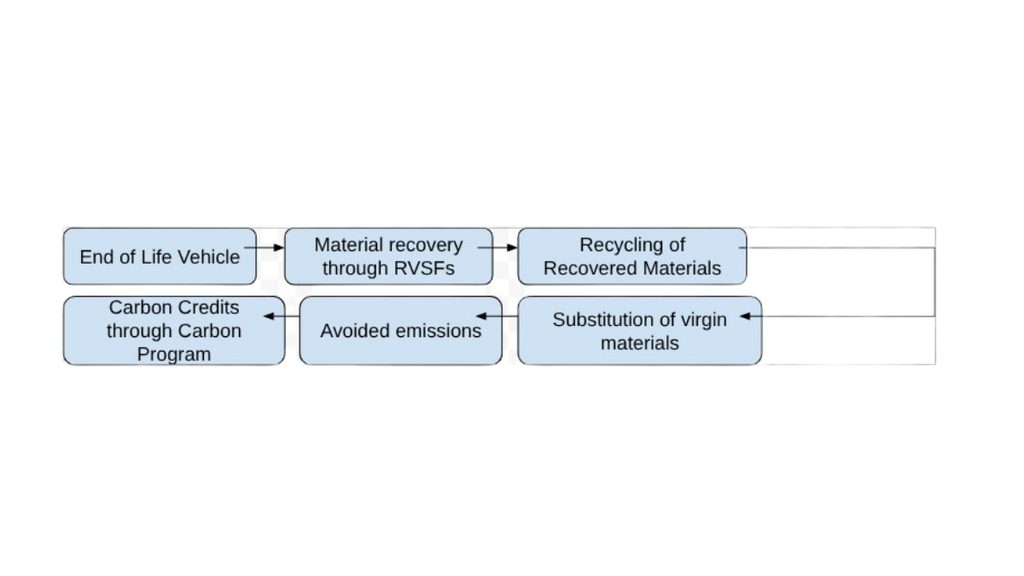
    Against this rapidly growing challenge, Meta Materials Circular Markets (MMCM) has helped address this gap through CM-WM-ELV-01 : Recovery and Recycling of Materials from End-of-Life Vehicles, a methodology approved under the Cercarbono certification programme.

    The methodology provides a framework to quantify the greenhouse-gas emission reductions associated with recovering and recycling materials from ELVs and reducing the need for equivalent virgin material production.

    In doing so, it takes vehicle scrapping beyond waste management and into the carbon market.

    A Global First for ELV Carbon Accounting

    The significance of the methodology lies in its focus: ELV material recovery and recycling as a dedicated carbon-crediting activity.

    Instead of looking at a scrapped vehicle simply as waste, the methodology recognises the climate value of recovering materials such as metals, plastics and other components and returning them to productive use.

    This creates a direct link between the physical circular economy and carbon finance:

    For a sector facing a rapidly increasing material stream, this represents a new way to mobilise climate finance towards formal vehicle recycling infrastructure.

    What Sets the MMCM Approach Apart?

    The methodology is designed to connect real-world material recovery with measurable climate outcomes, while creating a pathway for the growing ELV carbon recycling sector to access carbon finance.

    1. Connecting circularity with carbon finance
      The methodology creates a direct link between the recovery and recycling of materials from ELVs and the carbon market. By reducing the need for equivalent virgin material production, the recycling of eligible materials can generate measurable emissions reductions that can be quantified as carbon credits.
    2. Carbon value linked to actual material recovery
      The approach does not treat the number of vehicles scrapped as the carbon benefit in itself. Instead, it focuses on the recovery and recycling of materials and the associated emissions reductions. This creates a stronger connection between physical recycling activity and the climate impact being quantified.
    3. Designed for transparency and verification
      The methodology incorporates defined monitoring and documentation requirements, with project-level outcomes subject to validation and verification. This supports the development of transparent and auditable carbon assets and aligns the methodology with the growing market emphasis on carbon-credit integrity.
    4. Positioned within an evolving high-integrity carbon market
      The integrity of carbon markets is becoming increasingly important to buyers and market participants. In August 2026, Cercarbono was approved as CCP-Eligible by the Integrity Council for the Voluntary Carbon Market (ICVCM), following assessment of its governance, tracking, transparency and independent third-party verification systems. Cercarbono subsequently announced that CM-WM-ELV-01 is among five Cercarbono methodologies being submitted for the ICVCM’s methodology assessment process.

    Turning India’s ELV Challenge into a Climate Opportunity

    The scale of India’s ELV challenge makes the need for formal, sustainable recycling infrastructure increasingly important. According to the Ministry of Road Transport and Highways (MoRTH), as reported by the Press Information Bureau (PIB), as of 30 January 2026, 129 Registered Vehicle Scrapping Facilities (RVSFs) were operational across 21 States and Union Territories, having collectively scrapped approximately 0.43 million vehicles. As India continues to build out its formal vehicle-scrapping ecosystem, creating viable economic incentives for environmentally sound recovery and recycling will be critical.

    MMCM’s ELV carbon methodology provides a mechanism through which this growing formal recycling ecosystem can potentially access an additional source of climate finance, linking material recovery with measurable emissions reductions.

    The ambition is straightforward: as more vehicles reach the end of their useful lives, more of their materials can be recovered, recycled and returned to the economy, while the associated climate benefits can be measured and recognised through the carbon market.

    The result is a new proposition for the circular economy: a scrapped vehicle does not have to mark the end of its value. Its materials can begin a new lifecycle, while their recovery can contribute to measurable climate action and generate potential carbon-market value.

  • 70 Years of Building Trust

    70 Years of Building Trust

    New Delhi [India], September 29: A home is never just a home. It is the first place you learn to dream, the place you return to after a long day, and the space where some of life’s most important moments quietly happen. It is where a new family begins, where children grow up, where festivals are celebrated, where old stories are told, and new ones are made. And when we build a home, we want every part of it to last. We choose the colours, the furniture, the finishes, and every little detail with the hope that they will remain a part of our lives for years to come. For 70 years, Duroply has had the privilege of being part of that journey.

    Since 1957, generations of Indians have trusted Duroply to be part of the homes they build and the spaces they create. What began as a journey in plywood has grown over seven decades into a wider range of wood solutions, evolving alongside the way India lives, builds and designs. Homes today look very different from the homes of the past. Spaces have become more personalised, furniture has become more design-led, and consumers expect more from the materials they bring into their homes. Through these changes, Duroply has continued to innovate and expand its range with plywood, specialised plywood, doors, decorative veneers and engineered wood solutions designed for different needs and applications.

    But while products have evolved, the reason people choose them remains deeply personal. When you invest in your home, you want to know that what you choose today will continue to serve you tomorrow. You want your furniture to withstand everyday life, your spaces to remain dependable and the choices you make during construction to give you confidence long after the work is complete. That is where experience matters. Seven decades of understanding wood, manufacturing and changing consumer needs have helped Duroply build a legacy that goes beyond products. It has built a relationship of trust with generations of consumers.

    This is what 70 Saal Ka Bharosa represents. It is not simply about the number of years Duroply has been around. It is about the countless homes, rooms, kitchens, wardrobes and pieces of furniture that have been built with the confidence of choosing a brand with decades of experience behind it. It is about a trust that has grown from one generation to another. The home your parents built with confidence, the home you are building today and perhaps the home your children will build tomorrow are all part of a much bigger story.

    For Duroply, that trust also comes with the responsibility to stand behind what it makes. The brand’s Lifetime Guarantee on select plywood products reflects its confidence in their durability and performance. It gives consumers an assurance that their choice is backed by a commitment that goes beyond the point of purchase. The 3X Money Back promise takes that confidence a step further, offering an additional assurance to consumers and putting Duroply’s belief in its products firmly behind the choices they make for their homes.

    Because building a home is one of the most personal investments we make. It is not just about creating a beautiful space for today. It is about creating a space that can grow with us, adapt to our lives and hold everything that comes with them. The materials we choose become part of that story, often in ways we do not see every day but rely on every day. That makes trust an important part of the decision.

    For seven decades, Duroply has worked to earn that trust by combining experience with innovation and dependable quality. As homes continue to change and the expectations of consumers continue to grow, the brand remains committed to creating wood solutions that are made for the way people live today and the lives they will build tomorrow.

    Because trends may change. Designs may change. Homes may change. But the desire to build something that lasts never does.

    70 Saal Ka Bharosa. Lifetime Guarantee. 3X Money Back.

    Duroply. Built on 70 years of trust.

    If you object to the content of this press release, please notify us at pr.error.rectification@gmail.com. We will respond and rectify the situation within 24 hours.

  • NIS Management Limited Secures Rs 120+ Crore in Orders Since IPO, Highlights Growth at First AGM

    NIS Management Limited Secures Rs 120+ Crore in Orders Since IPO, Highlights Growth at First AGM

    Company expands its presence across government and private-sector clients, strengthens its operational footprint, and targets ₹500 crore in FY27 revenue

    Mumbai (Maharashtra) [India], September 30: NIS Management Limited (“NIS” or “the Company”), a diversified services provider in security, facility management, electronic surveillance and skill development, highlighted its FY26 performance, business expansion and strategic priorities at its first Annual General Meeting (AGM), held on September 25, 2026, since listing on the BSE SME platform on September 2, 2025.

    Addressing shareholders, Mr. Debajit Choudhury, Chairman & Managing Director, outlined the Company’s growth journey, strengthening financial position and expanding client relationships. NIS Management Limited First AG…

    Overall FY26 Performance

    NIS reported total income of ₹436.70 crore in FY26, registering a growth of 7.74% over ₹405.33 crore in FY25. EBITDA increased by 12.19% to ₹33.53 crore, with margins improving to 7.68%. Adjusted Profit After Tax stood at ₹19.12 crore.

    The Company’s balance sheet strengthened, with net worth reaching ₹196 crore and the debt-to-equity ratio declining to 0.42x. Q4 FY26 was the strongest quarter in the Company’s history, with total income of ₹118.03 crore and an EBITDA margin of 9.41%.

    ₹120.14 Crore in Orders Secured Since IPO

    Since its listing in September 2025, NIS has secured and intimated work orders aggregating approximately ₹120.14 crore, reflecting its growing presence across government, public-sector and private-sector clients.

    Key orders include:

    • Reliance Group: ₹30.77 crore from Reliance Projects & Property Management Services Limited and an additional ₹14.94 crore mandate.
    • Bihar: Two five-year contracts worth ₹19.57 crore and ₹14.65 crore from the Building Construction Department, Patna, and an additional ₹10.36 crore order from the Central Building Division.
    • West Bengal: ₹11.90 crore from West Bengal State Electricity Distribution Company Limited, alongside mandates from the Irrigation & Waterways Directorate, WEBEL and the Public Works Department.
    • Maharashtra: ₹2.18 crore CCTV surveillance mandate from Mumbai Police, secured by the Company’s electronic security subsidiary.
    • Skill Development: ₹7.93 crore DDU-GKY project from ORMAS, Odisha, and ₹1.50 crore from the Government of West Bengal.

    The orders span facility management, security, electronic surveillance, infrastructure support and skill development, strengthening the Company’s geographic reach and service portfolio. NIS Management Limited First AG…

    Expanding Geographic Presence and Client Base

    During FY26, NIS expanded its operations across Bihar, Maharashtra and Gujarat while strengthening its presence in West Bengal. Key developments included housekeeping services at the Bihar Secretariat, CCTV projects in Maharashtra, deployment across approximately 130 to 140 Reliance Retail stores in Gujarat and operations at Haldia Dock.

    Several contracts commenced towards the latter part of FY26, with their larger revenue contribution expected in FY27 as operations scale up.

    Strong Start to FY27

    NIS continued its growth momentum in FY27, reporting total income of ₹115.44 crore, up 15.68% year-on-year. EBITDA increased by over 36%, while Profit After Tax grew by 35% to ₹6.40 crore.

    The Company’s workforce has expanded to more than 19,100 employees, supporting operations across approximately 1,500 sites in fourteen states. ICRA reaffirmed its short-term rating at A2 and revised its long-term outlook from BBB+ Stable to BBB+ Positive. NIS SME also received Rhodium status under the State Bank of India’s SME Star Rating Programme in August 2026.

    FY27 Outlook

    NIS aims to cross ₹500 crore in consolidated revenue in FY27, supported by the mobilisation of recently secured contracts, expansion into new geographies and deeper client relationships.

    The Company will focus on integrated facility management, technology-led services, disciplined receivables management and improving execution efficiency to support sustainable growth.

    Chairman & Managing Director’s Message

    Mr. Debajit Choudhury, Chairman & Managing Director, NIS Management Limited, said:

    “FY26 has been an important year in NIS’s journey, marked by our transition into a listed company, continued operational expansion and a stronger financial position. Securing work orders aggregating approximately ₹120 crore since our listing reflects the trust placed in us by established private-sector organisations and government institutions.

    As we move into FY27, our focus remains on expanding our geographic presence, strengthening client relationships and broadening our capabilities across security, facility management, electronic surveillance and skill development. We remain committed to converting our growing order book into sustainable growth and achieving our revenue objective of ₹500 crore.” NIS Management Limited First AG…

    About NIS Management Limited

    NIS Management Limited, founded in Kolkata in 1985 as a security and investigative services provider, became a corporate entity in 2006. Over the years, the company expanded into facility management, electronic security, and skill development. Today, it manages a workforce of about 18,000 personnel, including back-office staff, across 14 states, supporting operations at approximately 1,500 sites.

    Its clientele includes corporates, banks, hospitality groups, manufacturing units, healthcare institutions, public sector enterprises, airports, and retail companies. The company also operates NIS Facility Management Services Private Limited for electronic security solutions and Keertika Academy Private Limited, an NSDC-recognized training partner.

    Looking ahead, the company plans to strengthen its position in integrated facility management through targeted service expansion, greater technology adoption, and a shift towards higher-value, margin-accretive offerings, complemented by strategic partnerships or acquisitions. Its long-term vision and mission underline professional service delivery, sustainable growth, and workforce empowerment.

    The company was listed on the BSE SME platform on 2 September 2025.

    Disclaimer: Certain statements in this document that are not historical facts are forward looking statements. Such forward-looking statements are subject to certain risks and uncertainties like government actions, local, political or economic developments, technological risks, and many other factors that could cause actual results to differ materially from those contemplated by the relevant forward-looking statements. The Company will not be in any way responsible for any action taken based on such statements and undertakes no obligation to publicly update these forward-looking statements to reflect subsequent events or circumstances.